27 January 2009

AIG’s Milton Gets Four Years for Fraud, Avoids Life. Fuld sells mansion to Wife for US$100. After Pressure from Obama, Citigroup Doesn't Take Jet.

Original Post: Jane Mills and David Voreacos - Bloomberg.com
Photographs: A. Golden, eyewash design, c. 2009.

Jan. 27 (Bloomberg) -- A former vice president at American International Group Inc. was sentenced to four years in prison for defrauding shareholders, avoiding a possible life term.

Christian Milton, 61, was convicted Feb. 25 with four former executives of General Reinsurance Corp. of using a sham transaction in 2000 to help AIG improve its balance sheet. The judge could have given Milton a life sentence after ruling that the fraud cost AIG shareholders as much as $597 million.

Milton asked U.S. District Judge Christopher Droney for a “minimal” term, citing his good work in the community. Droney said that while life in prison would be too severe, the sentence must deter other executives, and that Milton’s conduct showed a “stark lack of honesty and respect” for investors.

“Mr. Milton’s participation in this fraud was critical to its success, and particularly disturbing,” Droney said in federal court in Hartford, Connecticut. “He surely knew it was a scam from the start.”

Droney also imposed a $200,000 fine and ordered two years of supervised release after Milton’s term ends. Milton, a legal permanent resident of the U.S., faces deportation to his native England after his prison term.

U.S. prosecutors said Milton played a central role in a transaction that began in October 2000 with a phone call from former AIG Chief Executive Officer Maurice “Hank” Greenberg.

“He could have and should have told Mr. Greenberg that this was a shady deal and he would have nothing to do with it,” Assistant U.S. Attorney Raymond E. Patricco Jr. told the judge today. “Instead, he became the point man for the deal.”

Greenberg

Prosecutors have said Greenberg was an unindicted coconspirator in the case. Greenberg, who resigned in 2005, wasn’t charged with a crime and denied any knowledge of an improper transaction.

Milton was fired from AIG in March 2005 and hired within days at C.V. Starr & Co., an insurance and investment company run by Greenberg, Patricco said today. Milton makes $425,000 a year at C.V. Starr, according to Patricco.

“To this day, Mr. Greenberg remains his boss and holds the purse strings” to his deferred compensation, Patricco told the judge.

An attorney for Greenberg who attended today’s hearing, Scott Morvillo, declined comment. Amy Foote, a spokeswoman for C.V. Starr, also declined comment.

Milton will surrender to the U.S. Bureau of Prisons by March 25. He may apply for bail pending appeal. If the judge grants his request, it would delay the start of his prison term.

Leniency Sought
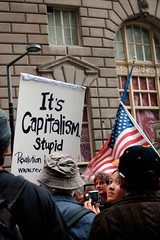
Milton, who submitted 67 letters to the judge seeking leniency, declined to speak at the hearing.

His attorney, Frederick Hafetz, said Milton deserved leniency for a variety of good acts, including intervening at AIG on behalf of two employees who had contracted AIDS.

“Mr. Milton, time after time, is the individual who stood up and showed compassion and courage when people were in trouble at work,” Hafetz said.

The deal at the center of the fraud arose after New York- based AIG said on Oct. 26, 2000, that premiums increased in the third quarter of 2000 as reserves for claims fell. Five days later, Greenberg asked Ferguson for help with AIG’s loss reserves, a key measure of an insurer’s success, according to trial evidence.

General Re, based in Stamford, Connecticut, agreed in writing to transfer at least $500 million in policies and pay $500 million in premiums, with AIG facing as much as $100 million in losses. AIG improperly booked the deal as posing a risk of loss, while General Re accounted for it correctly, prosecutors said. Secret side agreements corrupted the deal, according to the government.

On Dec. 16, Droney sentenced former General Re Chief Executive Officer Ronald Ferguson to two years in prison and fined him $200,000. He also faced a possible life term.

The case is U.S. v. Ferguson, 06-cr-137, U.S. District Court, District of Connecticut (Hartford).

-----NEW$ UPDATE$ on OTHER CORPORATE CRIMINAL$-----

Lehman Brothers' Richard Fuld "sold" mansion to wife for US$100

Original Post: Christine Seib in New York, The Times, London - January 27, 2009.

The disgraced chief executive of Lehman Brothers transferred ownership of a $14 million Florida mansion to his wife for $100 in a possible attempt to move assets beyond the reach of infuriated investors of the collapsed bank.

Richard Fuld, who led the 158-year-old investment bank to its demise last September, sold the beach-front house to his wife, Kathleen, for $100 (£72) on November 10, according to Marin County real estate records.

The couple had previously jointly owned the Jupiter Island property, which was valued at $13.75million when they bought it in March 2004.

Cityfile.com, the New York website that uncovered the secret sale, speculated: “Could Fuld be worried about the flurry of lawsuits from incensed shareholders and creditors?”

The 3.3-acre property is one of five luxury homes owned by the Fulds, who spend most of their time at their eight-bedroom mansion in Greenwich, Connecticut.

Mr Fuld has been named in at least one lawsuit filed by San Mateo County seeking damages for the collapse of Lehman Brothers. The Californian local authority lost $150 million on its investment in the Wall Street bank.

Lawyers were divided yesterday over whether the decision to move the mansion into Mrs Fuld's name was an attempt to put assets beyond the reach of investors who intend to sue the former chief executive for compensation. Some lawyers cited Florida's unusually generous home protection laws, which could save the Fulds from losing their house in the event of a lawsuit or bankruptcy.

To take advantage of these rules the couple would have to prove that they resided in Florida, which could be difficult because of the amount of time they spent in New York. Also, if a court decided that Mrs Fuld did not pay enough for the mansion, the transfer would be deemed to be “fraudulent conveyance” that would render the move void, lawyers said.

However, Barry Nelson, an attorney who specialises in asset preservation, said that the mansion would have been protected from creditors under Florida law even if it had remained in joint ownership. “As long as the acquisition of the property was not a fraud on creditors, which it wasn't because it was bought when the bank was doing well, and the debt is only his, not hers, then the property would be protected,” Mr Nelson said.

Since the collapse of Lehman Brothers, the 62-year-old banker, whose combative nature earned him the nickname The Gorilla, has become the symbol of everything that was wrong with Wall Street.

Even after overseeing America's largest bankruptcy, Mr Fuld has refused to admit responsibility for the fate of Lehman Brothers. Questioned by a congressional committee last October, Mr Fuld said that he felt

“horrible about what has happened to the company” but insisted that financial regulators and Congress should share the blame for the demise of the bank.

Mr Fuld also insisted that all his decisions in the months before the bankruptcy were “both prudent and appropriate” given the information that he had at the time.

He was paid $22 million in 2007 but did not receive any bonus or severance payment when he left Lehman Brothers last year. Henry Waxman, a Democrat Congressman, calculated that Mr Fuld had collected $480 million in compensation in eight years at the bank - a figure that Mr Fuld disputed, pointing out that he had taken home $300 million.

According to reports, Mr Fuld was running on a treadmill in the bank's gym, on the day he announced that Lehman Brothers was bankrupt, when he was punched in the face by an irate employee.

Mr Fuld's attorney did not return calls for comment yesterday.

Citigroup will not take possession of new aircraft

- Jan 27, 4:02 PM EST

NEW YORK (AP) -- Pressured by the Obama administration, Citigroup Inc. reversed course and said it will not take delivery of a corporate jet it previously planned to purchase.

The canceled deal comes amid a chorus of concerns from politicians who are worried about how banks that have received federal funds are spending the money. Citigroup has received $45 billion in capital from the government in recent months amid the ongoing credit crisis.

"Citi has no intent to take delivery of any new aircraft," the New York-based bank said in a statement Tuesday.

An official in President Barack Obama's administration reached out to Citigroup on Monday to reiterate Obama's position that such jets aren't "the best use of money at this point," and are "an outrageous use of funds" for a company getting taxpayer dollars, said a White House official who spoke on condition of anonymity to more freely describe private conversations.

In a statement late Monday, Citi said it had placed a deposit in 2005 to acquire a new corporate jet, and said it didn't plan to use government funds for the purchase. The New York-based bank noted that any cancellation of the deal would likely lead to millions of dollars in penalties.

On Monday, the New York Post reported that Citi was set to take possession of a new corporate jet, and was still planning to receive it even after it received the government funding.

With the cancellation of the deal, a deposit on the jet will be lost, but is recoverable once the jet is sold, according to a person familiar with situation. Citi was in the process of purchasing a Dassault Falcon 7X for $50 million, the person said.

Aside from not taking control of a new jet, Citi is also planning to cut the number of corporate jets in its existing fleet to two from five, said the person, who asked not to be identified because those details haven't been made public.

Corporate jets have become a hot-button topic amid the ongoing credit crisis as the cost of owning and operating them has come into question, especially for companies receiving financial support from the government.

In November, executives of automakers Ford Motor Co., General Motors Corp. and Chrysler LLC were roundly criticized for flying on corporate jets to Washington to ask Congress for federal bailout money.

Obama criticized the automakers during the transition, and White House press secretary Robert Gibbs told reporters at his daily briefing on Monday that that view applied in the Citi case as well. So an official from the Treasury Department relayed this privately to Citi, saying it was the feeling of not just the president but also lawmakers on Capitol Hill and the public, according to the White House official who spoke anonymously.

Citi has been among the hardest hit banks by rising loan defaults and souring investments, and been one of the biggest receivers of government support.

The bank has received $45 billion in capital from the government as part of the U.S. Treasury Department's plan to directly invest in banks. The government is also providing guarantees on hundreds of billions of dollars of Citi investments in mortgages and other troubled investments.

Amid the struggles, Citi has been working to streamline its operations and shed assets in an effort to regain profitability. The bank has posted five consecutive quarterly losses, including a fourth-quarter loss of $8.29 billion.

Earlier this month, Citi reached a deal to sell a majority stake in its Smith Barney brokerage unit to Morgan Stanley. Citi has also announced plans split its operations into two units, separating its traditional banking businesses from its riskier operations.

It might take a while for Citi to recover its deposit on the canceled jet deal, as the market for corporate aircraft has softened with the economy.

Before the jet market cooled last year, speculators sometimes placed orders with no intention of taking delivery of the plane. They would sell their position in line.

"There was such a backlog - three or three-and-a-half year waits - people could buy positions and flip them for a profit," said Robert F. Agnew, president and chief executive of aviation consulting firm Morton Beyer & Agnew. "Selling a slot today is probably very difficult."

Agnew said buyers typically pay a few percentage points of the purchase price when placing the order, then a series of payments as production begins and other milestones are reached. They might pay about 35 percent of the cost before taking delivery, then pay the balance when taking the plane, he said. At that rate, Citi could have already spent $17.5 million on a plane it will no longer receive.

Agnew did note that upfront costs can be much lower where a strong relationship exists between buyer and seller, but said he was not familiar with Citigroup's arrangement with Dassault.


LET THE REVOLUTION BEGIN!

Thanks for all you do!
Live your values. Love your country.
And, remember: TOGETHER, We can make a DIFFERENCE!

FAIR USE NOTICE: This blog may contain copyrighted material. Such material is made available for educational purposes, to advance understanding of human rights, democracy, scientific, moral, ethical, and social justice issues, etc. This constitutes a ‘fair use’ of any such copyrighted material as provided for in Title 17 U.S.C. section 107 of the US Copyright Law. In accordance with Title 17 U.S.C. Section 107, the material on this site is distributed without profit to those who have expressed a prior interest in receiving the included information for research and educational purposes. If you wish to use copyrighted material from this site for purposes of your own that go beyond ‘fair use’, you must obtain permission from the copyright owner.

26 January 2009

Lakotah Unilateral Withdrawal

Original Post: Republic of Lakotah, January 24, 2009 by admin.
Photographs:
A. Golden,
eyewash design, c. 2009
.

VIEW a television interview about this withdrawal

Lakotah Unilateral Withdrawal from All Agreements and Treaties with the United States of America

We as the freedom loving Lakotah People are the predecessor sovereign of Dakota Territory as evidenced by the Treaties with the United States Government, including, but not limited to, the Treaty of 1851 and the Treaty of 1868 at Fort Laramie.

Lakotah, formally and unilaterally withdraws from all agreements and treaties imposed by the United States Government on the Lakotah People. Lakotah , and the population therein, have waited for at least 155 years for the United States of America to adhere to the provisions of the above referenced treaties. The continuing violations of these treaties’ terms have resulted in the near annihilation of our people physically, spiritually, and culturally. Lakotah rejects United States Termination By Appropriation policy from 1871 to the present.

In addition, the evidence of gross violations of the above referenced treaties are listed herein. Lakotah encourages the United States of America, through its Government, to enter into dialogue with Lakotah regarding the boundaries, the land and the resources therein. Please contact the Republic of Lakotah at (605) 867-1111 or info@republicoflakotah.com.

Should the United States and its subordinate governments choose not to act in good faith concerning the rebirth of our nation, we hereby advise the United States Government that Lakotah will begin to administer liens against real estate transactions within the five state area of Lakotah.

Lakotah, through its government, appointed the following representatives to withdraw from all the treaties with the United States of America based on the Vienna Convention on the Law of Treaties entered into force in 1980 and the U.N. Declaration on the Rights of Indigenous Peoples 2007:

Teghiya Kte Canupa
Heretofore known as Gary Rowland

Gluha Mani
Heretofore known as Duane Martin Sr.

Oyate Wacinyapin
Heretofore know as Russell Means

Mni yuha Najin Win
Heretofore known as Phyllis Young

Political and Diplomatic Relations with the United States of America

The first official contacts between Lakotah and the government of the United States of America began in earnest after the United States conducted a commercial transaction with France, commonly known as the Louisiana Purchase, in1803. Prior to that time, Lakotah exercised complete and unfettered freedom and independence in their territory. According to the fantasy of United States’ history, the Louisiana Purchase was a purported sale by France to the United States of 530 million acres (2.1 million sq.km.) for $15 million. Part of this sale included the territory of Lakotah who, of course never had knowledge of, nor gave consent to, the sale of their national territory.

The first treaty between the U.S. and any segment of Lakotah occurred in 1805, and various other treaties of “peace and friendship,” between Lakotah and the U.S. As citizens of the U.S. began to invade and encroach on the territory of Lakotah in increasing numbers, tensions and violence erupted. To prevent full-scale war, the Fort Laramie Treaty of 1851 was requested by the U.S., to allow a transportation route through Lakotah territory. The treaty did not impair the sovereignty or the independence of Lakotah. In fact, the treaty expressly recognized Lakotah as an independent nation, and the treaty respected “all national business” of Lakotah.

After repeated violations by the United States of the 1851 Treaty, warfare broke out between Lakotah and the U.S. Lakotah defeated the U.S. in the so-called “Red Cloud War,” leading to the U.S. to call for another treaty conference at Fort Laramie. The second treaty agreed for the U.S. to abandon the Bozeman Road, and the accompanying military forts that had been built along it, and promised to keep U.S. troops and settlers out of Lakotah territory. Almost immediately, the U.S. began violating terms of the treaty, allowing railroad and mining interests to trespass and steal Lakotah resources and territory. In 1874, the infamous U.S. military commander, George Custer, led an invasion of the most sacred part of Lakotah territory, the Paha Sapa (Black Hills), prompting an invasion of gold seekers, and provoking another war between the U.S. and Lakotah. As a result of the war, Lakotah territory was illegally occupied by the U.S., and billions of dollars of natural resources have been stolen from the occupied territories of Lakotah.

The United States has engaged in multiple military, legal and political strategies for more than a century to deny Lakotah our right to freedom and self-determination. In 1876-77, in violations of the treaties that it had signed with Lakotah, the U.S. engaged in a sell-or-starve policy to coerce Lakotah to sell our national homeland. Lakotah refused, and has consistently refused to the present time.

In 1871, the U.S. decided no longer to enter into treaties with indigenous nations, but the U.S. treaty-ending legislation made explicit that the new policy of the United States would in no way impair or limit those treaties already in force between indigenous nations and the U.S. Lakotah have consistently relied on the sanctity of the treaty between the U.S. and Lakotah.

As mentioned above, the United States has consistently violated the treaties between Lakotah and the U.S., resulting in the loss of life, resources, and territory for Lakotah. Although the United States was willing to take the benefit of its bargain (i.e., territory and natural resources) in signing treaties with Lakotah, it was almost immediately unwilling to respect the mutual bargain to the Lakotah. The U.S. began to use U.S. law and policy to attempt to diminish the political, economic and cultural freedom of Lakotah. After signing the 1868 Fort Laramie Treaty, the U.S. allowed its military, and its civilian citizens to invade Lakotah territory to steal gold, silver and other natural resources. The U.S. unilaterally violated the 1868 Treaty throughout the 1870s and 1880s by coercing alterations in the Treaty onto Lakotah, without the required 2/3 agreement of Lakotah, as required in the Treaty.

Although the U.S. Supreme Court recognized the ongoing freedom and independence of Lakotah in the landmark case of Ex Parte Crow Dog (1883), two years later, the U.S. Congress attempted to steal Lakotah independence through the passage of the Major Crimes Act, that unilaterally extended U.S. criminal jurisdiction into Lakotah territory.

These actions were followed by more arrogant actions of the United States, culminating in the shocking Supreme Court Case of Lone Wolf v. Hitchcock (1903). Although Lone Wolf involved the Kiowa and Comanche Nations in what is now the State of Oklahoma, its impact adversely affected Lakotah. In Lone Wolf, the United States not only said that it could violate, change or abrogate treaties with Indian nations unilaterally, but it also said that the U.S. Congress possesses plenary (absolute) power to legislate in any way in indigenous affairs without the consent or consideration of indigenous nations.

By extension, Lone Wolf has been used to violate hundreds of treaties between the U.S. and indigenous peoples, including Lakotah. Through the operation of Lone Wolf, the U.S. stole the sacred Black Hills, allowed the mining of billions of dollars of gold from them, admitted that the Black Hills were taken in violation of the 1868 Fort Laramie Treaty, and then offered to compensate Lakotah at 1874 land values. Lakotah have, to this day, rejected the offer of payment, and continue to insist on the return of the Paha Sapa (Black Hills).

An overview of violations follows:

• Homestead Acts
• Allotment Acts
• Citizenship Act forcing United States citizenship upon all American Indians
• Indian Reorganization Act a.k.a. Howard Wheeler Act (the first Apartheid Act)
• Forced relocation during the decades of the 1950’s over the 1960’s.
• Supreme Court decision disallowing our religions.
• Even though we are citizens of the United States of America, we are denied
protections of the United States Constitution while living on Indian reservations, etcetera, etcetera, etcetera.

The operation of the United States in the nefarious ways outlined above are a violation, not only of the sovereignty and independence of Lakotah, not only of the solemn treaty signed between the U.S. and Lakotah, but it is a violation of the fundamental law of the United States itself. Article Six of the United States Constitution explicitly states that treaties signed by the United States are the supreme law of the land, and must be respected by every court and by every lawmaker, as such.

Referenced Documents:

1. Treaties of Fort Laramie, 1851 and 1868

2. Article VI of United States Constitution

Article. VI. - Debts, Supremacy, Oaths
All Debts contracted and Engagements entered into, before the Adoption of this Constitution, shall be as valid against the United States under this Constitution, as under the Confederation. This Constitution, and the Laws of the United States which shall be made in Pursuance thereof; and all Treaties made, or which shall be made, under the Authority of the United States, shall be the supreme Law of the Land; and the Judges in every State shall be bound thereby, any Thing in the Constitution or Laws of any State to the Contrary notwithstanding. The Senators and Representatives before mentioned, and the Members of the several State Legislatures, and all executive and judicial Officers, both of the United States and of the several States, shall be bound by Oath or Affirmation, to support this Constitution; but no religious Test shall ever be required as a Qualification to any Office or public Trust under the United States.

3. Vienna Convention on Treaties 1969; specifically Article 49,
Article 60 Parts I and II
Article 49- Fraud
If a State has been induced to conclude a treaty by the fraudulent conduct govern questions not regulated by the provisions of the present Convention, Have agreed as follows:

PART I INTRODUCTION
Article 1
Scope of the present Convention
The present Convention applies to treaties between States.
Article 2
Use of terms
1. For the purposes of the present Convention:
(a) ‘treaty’ means an international agreement concluded between States in written form and governed by international law, whether embodied in a single instrument or in two or more related instruments and whatever its particular designation;
(b) ‘ratification’, ‘acceptance’, ‘approval’ and ‘accession’ mean in each case the international act so named whereby a State establishes on the international plane its consent to be bound by a treaty;
(c) ‘full powers’ means a document emanating from the competent authority of a State designating a person or persons to represent the State for negotiating, adopting or authenticating the text of a treaty, for expressing the consent of the State to be bound by a treaty, or for accomplishing any other act with respect
to a treaty;
(d) ‘reservation’ means a unilateral statement, however phrased or named, made by a State, when signing, ratifying, accepting, approving or acceding to a treaty, whereby it purports to exclude or to modify the legal effect of certain provisions of the treaty in their application to that State;
(e) ‘negotiating State’ means a State which took part in the drawing up and adoption of the text of the treaty;
(f) ‘contracting State’ means a State which has consented to be bound by the treaty, whether or not the treaty has entered into force;
(g) ‘party’ means a State which has consented to be bound by the treaty and for which the treaty is in force;
(h) ‘third State’ means a State not a party to the treaty;
(i) ‘international organization’ means an intergovernmental organization.

Article 60
Termination or suspension of the operation of a treaty as a consequence of its breach
1. A material breach of a bilateral treaty by one of the parties entitles the other to invoke the breach as aground for terminating the treaty or suspending its operation in whole or in part.
2. A material breach of a multilateral treaty by one of the parties entitles:
(a) the other parties by unanimous agreement to suspend the operation of the treaty in
whole or in part or to terminate it either:
(i) in the relations between themselves and the defaulting State, or
(ii) as between all the parties;
(b) a party specially affected by the breach to invoke it as a ground for suspending the
operation of the
treaty in whole or in part in the relations between itself and the defaulting State;
(c) any party other than the defaulting State to invoke the breach as a ground for suspending the operation
of the treaty in whole or in part with respect to itself if the treaty is of such a character that a material breach of its provisions by one party radically changes the position of every party with respect to the further performance of its obligations under the treaty.
3. A material breach of a treaty, for the purposes of this article, consists in:
(a) a repudiation of the treaty not sanctioned by the present Convention; or
(b) the violation of a provision essential to the accomplishment of the object or purpose of the treaty.
4. The foregoing paragraphs are without prejudice to any provision in the treaty applicable in the event of a breach.
5. Paragraphs 1 to 3 do not apply to provisions relating to the protection of the human person contained in
treaties of a humanitarian character, in particular to provisions prohibiting any form of reprisals against persons protected by such treaties.
4. United Nations Declaration of Indigenous Rights 2007;
specifically Article 37
Article 37
1. Indigenous peoples have the right to the recognition, observance and enforcement of treaties, agreements and other constructive arrangements concluded with States or their successors and to have States honor and respect such treaties, agreements and other constructive arrangements.
2. Nothing in this Declaration may be interpreted as diminishing or eliminating the rights of indigenous peoples contained in treaties, agreements and other constructive arrangements.
5. Lone Wolf v. Hitchcock (1903)

Note: Lakotah precludes all litigation and political intrusions not relevant to Lakotah.


LET THE REVOLUTION BEGIN!

Thanks for all you do!
Live your values. Love your country.
And, remember: TOGETHER, We can make a DIFFERENCE!

FAIR USE NOTICE: This blog may contain copyrighted material. Such material is made available for educational purposes, to advance understanding of human rights, democracy, scientific, moral, ethical, and social justice issues, etc. This constitutes a ‘fair use’ of any such copyrighted material as provided for in Title 17 U.S.C. section 107 of the US Copyright Law. In accordance with Title 17 U.S.C. Section 107, the material on this site is distributed without profit to those who have expressed a prior interest in receiving the included information for research and educational purposes. If you wish to use copyrighted material from this site for purposes of your own that go beyond ‘fair use’, you must obtain permission from the copyright owner.

25 January 2009

Urge President Obama to elect a Secretary of Culture.

Original Post: Soundcheck, visa-vis WNYC.org: 21 January 2009.
Photographs: A. Golden, eyewash design, c. 2009.

A Secretary of the Arts for America?

When music impresario Quincy Jones appeared on Soundcheck in December, he said the first thing he would do is “beg” President Obama to establish a cabinet-level position for the arts. Today, we revisit that conversation with a debate on whether a “secretary for the arts” is really a good idea. Joining us are former National Endowment for the Humanities head William Ferris and Reason magazine columnist Ronald Bailey.

Listen to the entire show here.

Minister of Culture

In France, the government has had a minister of culture for over 50 years, but here in the U.S., a cabinet-level cultural affairs post has never existed. That could soon change, as members of President Obama's arts review transition team have expressed interest in creating an "arts czar" position. William Ferris, former head of the National Endowment for the Humanities, and Reason magazine columnist Ronald Bailey join us to discuss the possibility - and necessity - of a Secretary of Culture.

Soundcheck blog: John Schaefer on the "arts czar" question.

Tell us: What do you think of the "arts czar" idea? Should President Obama establish a secretary of the arts in his cabinet?

Ronald Baily's Culture Czar Column Post on Reason Online
William Ferris' NY Times op-ed, "Put Culture in the Cabinet"

Please consider signing the Quincy Jones petition, urging President Obama to appoint a Secretary of Culture. The petition can be found HERE.


LET THE REVOLUTION BEGIN!

Thanks for all you do!
Live your values. Love your country.
And, remember: TOGETHER, We can make a DIFFERENCE!

FAIR USE NOTICE: This blog may contain copyrighted material. Such material is made available for educational purposes, to advance understanding of human rights, democracy, scientific, moral, ethical, and social justice issues, etc. This constitutes a ‘fair use’ of any such copyrighted material as provided for in Title 17 U.S.C. section 107 of the US Copyright Law. In accordance with Title 17 U.S.C. Section 107, the material on this site is distributed without profit to those who have expressed a prior interest in receiving the included information for research and educational purposes. If you wish to use copyrighted material from this site for purposes of your own that go beyond ‘fair use’, you must obtain permission from the copyright owner.


20 January 2009

Democracy Now: Inauguration Edition - 1 of 5


LET THE REVOLUTION BEGIN!

Thanks for all you do!
Live your values. Love your country.
And, remember: TOGETHER, We can make a DIFFERENCE!

FAIR USE NOTICE: This blog may contain copyrighted material. Such material is made available for educational purposes, to advance understanding of human rights, democracy, scientific, moral, ethical, and social justice issues, etc. This constitutes a ‘fair use’ of any such copyrighted material as provided for in Title 17 U.S.C. section 107 of the US Copyright Law. In accordance with Title 17 U.S.C. Section 107, the material on this site is distributed without profit to those who have expressed a prior interest in receiving the included information for research and educational purposes. If you wish to use copyrighted material from this site for purposes of your own that go beyond ‘fair use’, you must obtain permission from the copyright owner.

19 January 2009

Happy MLK Day!


Headed to D.C. to cover THE EVENT of the Century! Will be attending the Native American Indian Inaugural Ball tomorrow evening. Images & stories to come. In the meantime...


LET THE REVOLUTION BEGIN!

Thanks for all you do!
Live your values. Love your country.
And, remember: TOGETHER, We can make a DIFFERENCE!

FAIR USE NOTICE: This blog may contain copyrighted material. Such material is made available for educational purposes, to advance understanding of human rights, democracy, scientific, moral, ethical, and social justice issues, etc. This constitutes a ‘fair use’ of any such copyrighted material as provided for in Title 17 U.S.C. section 107 of the US Copyright Law. In accordance with Title 17 U.S.C. Section 107, the material on this site is distributed without profit to those who have expressed a prior interest in receiving the included information for research and educational purposes. If you wish to use copyrighted material from this site for purposes of your own that go beyond ‘fair use’, you must obtain permission from the copyright owner.


15 January 2009

Notable NYC News: 15 Jan. 2009.

January 15, 2009 3:43 PM
Original Post: ABC News
By: RUSSELL GOLDMAN

US Airways Jet Crashes Into Hudson River off New York City


Flight 1549 Went Down After Being Struck by Birds.

Some 150 people aboard a US Airways plane en route to Charlotte, N.C., from New York City were rescued today in a lightning-fast effort following the jet's crash into the frigid waters of the Hudson River off the West Side of Manhattan.

All passengers and crew aboard were reported safe after New York City firefighters and ferries rushed to the aid of the US Airways jet, which floated in the river near the historic aircraft carrier The Intrepid.

US Airways flight 1549, an A-320 manufactured by Airbus, was carrying as many as 148 passengers and five or six crew members, according to the Port Authority of New York and New Jersey.

Only 30 seconds after takeoff at 3:26 p.m. ET, the pilot reported two bird strikes and said he wanted to return to LaGuardia Airport.

Controllers began giving him directions for return, but the pilot requested to land at the nearby Teterboro airport over New Jersey. The tower reportedly lost contact soon after that last transmission.

Commuter boats in the area were seen fishing people from the river, and rescuing passengers standing on the plane's wings after the crash.

ABC News' Robin Roberts, who saw the plane crash from her apartment window, said it appeared to be a controlled landing.

"It completely just hit the water full force, never bounced or anything like that, and came to a relatively quick stop," Roberts said. "But… it didn't skim along the water. There was very little trauma to the aircraft. It was… I'm still… can't believe what I saw."

The water temperature in the river was reported at 40 degrees, just above freezing.

John Ostrom of the Metropolitan Airports Commission out of Minneapolis chairs the Bird Strikes Committee, which advises the aviation industry on wildlife management to eliminate possible hazards.

"There's a variety of ways a bird can take down a plane," he told ABC News today. "There have been instances where birds the size of robins bring a plane down, all the way up to Canada geese."

Birds can fly into plane engines, shutting them down, or cause pilots to lose control of the plane by penetrating the windshield. And there's not much pilots can do to avoid bird strikes, which happen "every day," according Ostrom.

---------------------------------------------------------------------------------------------------------------------------------------------------------------------------

January 15, 2009 8:33 AM
Original Post: Cranes NY
Photograph: A. Golden, eyewash design, c. 2005.

Riders to hold mock funeral for Z subway line.

The Metropolitan Transportation Authority is proposing to eliminate the subway line as part of an effort to combat a billion-plus budget deficit for 2009.

(AP) - New York City transit advocates are planning to hold a mock funeral for a subway line that could be eliminated under proposed budget cuts.

A bagpiper is expected to join members of the Straphangers Campaign on Thursday as they place a memorial wreath for the Z line at the Fulton-Broadway-Nassau station in Manhattan.

The Metropolitan Transportation Authority is proposing to eliminate the subway line as part of an effort to combat a billion-plus budget deficit for 2009. It has also said it would substantially raise fares.

More than 300 people crowded showed up at the Hilton New York Hotel for a public hearing Wednesday night held to talk about the proposals.

Members of the crowd protested the fare increases, especially a plan to double fares paid by Access-A-Ride disabled riders.

---------------------------------------------------------------------------------------------------------------------------------------------------------------------------

January 15, 2009 8:21 AM
Illustration: A. Golden, eyewash design, c. 2007.

Mayor Bloomberg to reveal news jobs plan.


Mayor Michael Bloomberg's nine-point plan to create 400,000 jobs is one of several ideas he will present during a State of the City Address, Thursday.

(AP) - Mayor Michael Bloomberg was to outline a six-year plan to create 400,000 jobs during a State of the City speech focusing on economic recovery from the city's fiscal downturn.

The nine-point plan is one of several new economic ideas the billionaire former chief executive officer would present Thursday, according to people familiar with the speech. Themes of the annual address were described to The Associated Press on Wednesday by officials who spoke on condition of anonymity because the speech had not been given.

The job creation plan includes efforts to help small businesses, support for projects that create green jobs and a focus on capital investments that will yield work for residents.

Mr. Bloomberg on Wednesday spoke in broad terms about the city's dismal economic state and what the city would hear from him during the speech, which was expected to last more than an hour.

"We can't pray our ways out of this," he said. "We can't hope our ways out of it. We can't depend on things always breaking the right way to get us through it. We're going to have to have some reserves in case things don't go the way we think, in case things are worse."

Mr. Bloomberg has staked his campaign for a third term this year on his financial expertise and ability to guide the city through tough economic times.

He said Wednesday that he would not be unveiling any flashy new spending but would stick to initiatives that don't cost a lot of extra money.

Independent city budget analysts forecast in a report last week that the city will lose 242,700 jobs through the end of 2010. The report also projected that the budget gap for next fiscal year, which begins in July, has ballooned to $4.3 billion. In November, Mr. Bloomberg's prediction was $1.3 billion.

Among the points of the job creation plan is a proposal to reduce or eliminate the unincorporated business tax, helping ease the burden for 17,000 small business owners citywide, the officials said.

Aides said Mr. Bloomberg would seek to rise above the theme of doom and gloom in his speech on Thursday, instead turning to ways the city can get through the financial mess.

There will be plenty of time for bad news. The mayor will follow his State of the City address at the end of the month with a new budget plan, which is expected to contain new cuts and tax hikes.

"It will be very sobering to lay out the realities," he said Wednesday.

---------------------------------------------------------------------------------------------------------------------------------------------------------------------------

January 15, 2009 11:42 AM
Photograph: A. Golden, eyewash design, c. 2005.

Most New Yorker's don't want 'Fat Tax' on soda.

A Quinnipiac poll reports 64% of registered New York voters oppose the governor's plan to help combat widespread obesity through an 18% tax on sugary drinks.

(AP) - Most New Yorkers are balking at Gov. David Paterson's proposal to impose a "fat tax" on sugary drinks, but an even larger majority wants millionaires to hand over a bigger share of their earnings to the tax collector, according to a new poll.

Quinnipiac University reported Thursday that 64% of registered voters oppose the governor's plan to help combat widespread obesity among children and others through an 18% tax on sugary drinks containing less than 70% real fruit juice. The poll shows 32% favor the soda surcharge.

"One month after Gov. David Paterson rolled out his fat tax proposal, and one week after he gave it a big push in his State of the State message, opposition is growing weightier instead of slimmer," said Maurice Carroll, director of the Quinnipiac University Polling Institute.

That compares with 60% opposition and 37% support in a December survey. Quinnipiac said it surveyed 1,664 voters from Jan. 8-12 and the new poll has a margin of error of 2.4 percentage points.

"One out of every four New Yorkers under 18 years of age is obese," Mr. Paterson said in his State of the State address last week. That blights their futures and creates a significant economic burden, he said, with New York spending $6.1 billion annually to treat obesity-related health problems.

Mr. Paterson's plan would ban trans fats in restaurants and junk food sales in schools. He would require chain restaurants statewide to post calorie content and establish a revolving loan fund to get healthy food markets in poor communities.

But the part of his plan that would add the surcharge on sugared drinks lacked poll support even among New York voters who prefer diet sodas, with 62% opposed and 35% in favor. Opposition was higher among those who drink sugared sodas, 72% against and 26% in favor.

Support for raising taxes on those with annual income more than $1 million a year stood at 80%, with 16% opposed. That drops to 73% support for higher taxes on incomes more than $500,000 a year, and 55% for incomes more than $250,000.

"We'd like to tax millionaires and even half-millionaires," Mr. Carroll said. "But the support begins to erode when we drop the high-tax level to $250,000, too close to home for many voters."

Mr. Paterson's 2009-2010 budget proposal would establish 88 new or higher fees or taxes, but he declined to embrace the Assembly Democrats' proposal to increase the income tax rate on New Yorkers with incomes $1 million or more a year.

The Quinnipiac survey found 53% of voters approve of the job Paterson is doing, with 25% opposed. They split 42-43% on his handling of the state budget, up from 40-46% last month.

Only 20% said they thought state lawmakers have the courage to make unpopular budget decisions, while 71% said they thought it would be "business as usual" in Albany.


LET THE REVOLUTION BEGIN!

Thanks for all you do!
Live your values. Love your country.
And, remember: TOGETHER, We can make a DIFFERENCE!

FAIR USE NOTICE: This blog may contain copyrighted material. Such material is made available for educational purposes, to advance understanding of human rights, democracy, scientific, moral, ethical, and social justice issues, etc. This constitutes a ‘fair use’ of any such copyrighted material as provided for in Title 17 U.S.C. section 107 of the US Copyright Law. In accordance with Title 17 U.S.C. Section 107, the material on this site is distributed without profit to those who have expressed a prior interest in receiving the included information for research and educational purposes. If you wish to use copyrighted material from this site for purposes of your own that go beyond ‘fair use’, you must obtain permission from the copyright owner.

ACTION ALERT! Tell Congress to Support Unemployment Insurance Reform as Part of Economic Recovery


Dear Friends --

We need your help right away to make the case to Congress that the economic recovery legislation now being debated should help all hard-working families collect unemployment benefits. As described below, please email your Congressional Representatives and Senators to support the Unemployment Insurance Modernization Act.

(Link to Email Congress)

Although you may be receiving unemployment insurance checks right now, did you know that only 37% of unemployed workers actually receive unemployment? True, some lose or quit their jobs under circumstances that leave them ineligible to collect unemployment, but far too many workers, especially low wage and women workers, fall through the cracks of the system.

That's because their states still have eligibility rules developed for the workforce of the Great Depression, not today’s workforce in which people work part-time in order to help balance their work and family responsibilities, in which there is a larger low-wage workforce than ever before (ONE in THREE jobs), and in which people, largely women, have to involuntarily leave their jobs because of compelling family circumstances such as caring for an ill child or moving because of a spouse’s mandatory job transfer.

An important piece of federal legislation, the Unemployment Insurance Modernization Act (UIMA), would provide states with generous financial incentives ($7 billion) to enact reforms of their programs that about 20 states have already enacted. These reforms have a proven track-record of making sure that more deserving workers qualify for unemployment when they lose their jobs through no fault of their own. The states that have already enacted these reforms will also be rewarded with generous grants that they can use to continue to expand and improve coverage.

If passed, the UIMA would also provide ALL states with much needed money ($500 million) to help improve their administration and delivery of benefits. As we have heard from so many of you, the states are really struggling to process your unemployment claims and get back to families with the unemployment checks. So this federal money to the states is desperately needed to help the state unemployment agencies staff up and fix their crashing systems.

As tough as things might be for you right now (only receiving unemployment insurance rather than a paycheck), imagine how much worse it would be if you didn’t even receive those UI checks. That’s the situation the UIMA is designed to remedy.

By clicking this link, you will be able to send an email to your representatives in Congress, telling them to support the UIMA and include it in the economic stimulus and recovery legislation that will be enacted early this year. We need your help right away, as Congress and President-elect Obama are very close to making final decisions about the economic recovery legislation, including the UIMA.

The clock is ticking and the economy is continuing to shed jobs. PLEASE take just a few short minutes of your time to HELP SUPPORT this important initiative that will help cover approximately 500,000 MORE workers qualify for unemployment benefits with the help of the Unemployment Insurance Modernization Act.

Here's a link to our fact sheet with more details on the UIMA.

Many thanks!

Maurice, Andy, Judy, Christine and Debbie, NELP


LET THE REVOLUTION BEGIN!

Thanks for all you do!
Live your values. Love your country.
And, remember: TOGETHER, We can make a DIFFERENCE!

FAIR USE NOTICE: This blog may contain copyrighted material. Such material is made available for educational purposes, to advance understanding of human rights, democracy, scientific, moral, ethical, and social justice issues, etc. This constitutes a ‘fair use’ of any such copyrighted material as provided for in Title 17 U.S.C. section 107 of the US Copyright Law. In accordance with Title 17 U.S.C. Section 107, the material on this site is distributed without profit to those who have expressed a prior interest in receiving the included information for research and educational purposes. If you wish to use copyrighted material from this site for purposes of your own that go beyond ‘fair use’, you must obtain permission from the copyright owner.