Showing posts with label Politicians. Show all posts

31 March 2009

Obama’s Ersatz Capitalism.

by: Joseph E. Stiglitz
Op-Ed Contributor
March 31, 2009.

THE Obama administration’s $500 billion or more proposal to deal with America’s ailing banks has been described by some in the financial markets as a win-win-win proposal. Actually, it is a win-win-lose proposal: the banks win, investors win — and taxpayers lose.

Treasury hopes to get us out of the mess by replicating the flawed system that the private sector used to bring the world crashing down, with a proposal marked by overleveraging in the public sector, excessive complexity, poor incentives and a lack of transparency.

Let’s take a moment to remember what caused this mess in the first place. Banks got themselves, and our economy, into trouble by overleveraging — that is, using relatively little capital of their own, they borrowed heavily to buy extremely risky real estate assets. In the process, they used overly complex instruments like collateralized debt obligations.

The prospect of high compensation gave managers incentives to be shortsighted and undertake excessive risk, rather than lend money prudently. Banks made all these mistakes without anyone knowing, partly because so much of what they were doing was “off balance sheet” financing.

In theory, the administration’s plan is based on letting the market determine the prices of the banks’ “toxic assets” — including outstanding house loans and securities based on those loans. The reality, though, is that the market will not be pricing the toxic assets themselves, but options on those assets.

The two have little to do with each other. The government plan in effect involves insuring almost all losses. Since the private investors are spared most losses, then they primarily “value” their potential gains. This is exactly the same as being given an option.

Consider an asset that has a 50-50 chance of being worth either zero or $200 in a year’s time. The average “value” of the asset is $100. Ignoring interest, this is what the asset would sell for in a competitive market. It is what the asset is “worth.” Under the plan by Treasury Secretary Timothy Geithner, the government would provide about 92 percent of the money to buy the asset but would stand to receive only 50 percent of any gains, and would absorb almost all of the losses. Some partnership!

Assume that one of the public-private partnerships the Treasury has promised to create is willing to pay $150 for the asset. That’s 50 percent more than its true value, and the bank is more than happy to sell. So the private partner puts up $12, and the government supplies the rest — $12 in “equity” plus $126 in the form of a guaranteed loan.

If, in a year’s time, it turns out that the true value of the asset is zero, the private partner loses the $12, and the government loses $138. If the true value is $200, the government and the private partner split the $74 that’s left over after paying back the $126 loan. In that rosy scenario, the private partner more than triples his $12 investment. But the taxpayer, having risked $138, gains a mere $37.

Even in an imperfect market, one shouldn’t confuse the value of an asset with the value of the upside option on that asset.

But Americans are likely to lose even more than these calculations suggest, because of an effect called adverse selection. The banks get to choose the loans and securities that they want to sell. They will want to sell the worst assets, and especially the assets that they think the market overestimates (and thus is willing to pay too much for).

But the market is likely to recognize this, which will drive down the price that it is willing to pay. Only the government’s picking up enough of the losses overcomes this “adverse selection” effect. With the government absorbing the losses, the market doesn’t care if the banks are “cheating” them by selling their lousiest assets, because the government bears the cost.

The main problem is not a lack of liquidity. If it were, then a far simpler program would work: just provide the funds without loan guarantees. The real issue is that the banks made bad loans in a bubble and were highly leveraged. They have lost their capital, and this capital has to be replaced.

Paying fair market values for the assets will not work. Only by overpaying for the assets will the banks be adequately recapitalized. But overpaying for the assets simply shifts the losses to the government. In other words, the Geithner plan works only if and when the taxpayer loses big time.

Some Americans are afraid that the government might temporarily “nationalize” the banks, but that option would be preferable to the Geithner plan. After all, the F.D.I.C. has taken control of failing banks before, and done it well. It has even nationalized large institutions like Continental Illinois (taken over in 1984, back in private hands a few years later), and Washington Mutual (seized last September, and immediately resold).

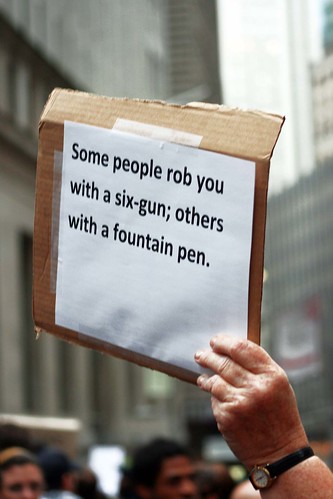
What the Obama administration is doing is far worse than nationalization: it is ersatz capitalism, the privatizing of gains and the socializing of losses. It is a “partnership” in which one partner robs the other. And such partnerships — with the private sector in control — have perverse incentives, worse even than the ones that got us into the mess.

So what is the appeal of a proposal like this? Perhaps it’s the kind of Rube Goldberg device that Wall Street loves — clever, complex and nontransparent, allowing huge transfers of wealth to the financial markets. It has allowed the administration to avoid going back to Congress to ask for the money needed to fix our banks, and it provided a way to avoid nationalization.

But we are already suffering from a crisis of confidence. When the high costs of the administration’s plan become apparent, confidence will be eroded further. At that point the task of recreating a vibrant financial sector, and resuscitating the economy, will be even harder.

Joseph E. Stiglitz, a professor of economics at Columbia who was chairman of the Council of Economic Advisers from 1995 to 1997, was awarded the Nobel prize in economics in 2001.


LET THE REVOLUTION BEGIN!

Thanks for all you do!
Live
your values. Love your country.
And, remember: TOGETHER, We can make a DIFFERENCE!

FAIR USE NOTICE: This blog may contain copyrighted material. Such material is made available for educational purposes, to advance understanding of human rights, democracy, scientific, moral, ethical, and social justice issues, etc. This constitutes a ‘fair use’ of any such copyrighted material as provided for in Title 17 U.S.C. section 107 of the US Copyright Law. In accordance with Title 17 U.S.C. Section 107, the material on this site is distributed without profit to those who have expressed a prior interest in receiving the included information for research and educational purposes. If you wish to use copyrighted material from this site for purposes of your own that go beyond ‘fair use’, you must obtain permission from the copyright owner.

17 December 2008

With economy in shambles, Congress gets a raise.

With the economy in shambles, Congress gets a raise.
Posted: 12/17/08 05:41 PM
Photographer: A. Golden, eyewash design, c. 2008.

A crumbling economy, more than 2 million constituents who have lost their jobs this year, and congressional demands of CEOs to work for free did not convince lawmakers to freeze their own pay.

Instead, they will get a $4,700 pay increase, amounting to an additional $2.5 million that taxpayers will spend on congressional salaries, and watchdog groups are not happy about it.

Instead, they will get a $4,700 pay increase, amounting to an additional $2.5 million that taxpayers will spend on congressional salaries, and watchdog groups are not happy about it.

“As lawmakers make a big show of forcing auto executives to accept just $1 a year in salary, they are quietly raiding the vault for their own personal gain,” said Daniel O’Connell, chairman of The Senior Citizens League (TSCL), a non-partisan group. “This money would be much better spent helping the millions of seniors who are living below the poverty line and struggling to keep their heat on this winter.”

However, at 2.8 percent, the automatic raise that lawmakers receive is only half as large as the 2009 cost of living adjustment of Social Security recipients.

Still, Steve Ellis, vice president of the budget watchdog Taxpayers for Common Sense, said Congress should have taken the rare step of freezing its pay, as lawmakers did in 2000.

“Look at the way the economy is and how most people aren’t counting on a holiday bonus or a pay raise — they’re just happy to have gainful employment,” said Ellis. “But you have the lawmakers who are set up and ready to get their next installment of a pay raise and go happily along their way.”

Member raises are often characterized as examples of wasteful spending, especially when many constituents and businesses in members’ districts are in financial despair.

Rep. Harry Mitchell, a first-term Democrat from Arizona, sponsored legislation earlier this year that would have prevented the automatic pay adjustments from kicking in for members next year. But the bill, which attracted 34 cosponsors, failed to make it out of committee.

“They don’t even go through the front door. They have it set up so that it’s wired so that you actually have to undo the pay raise rather than vote for a pay raise,” Ellis said.

Freezing congressional salaries is hardly a new idea on Capitol Hill.

Lawmakers have floated similar proposals in every year dating back to 1995, and long before that. Though the concept of forgoing a raise has attracted some support from more senior members, it is most popular with freshman lawmakers, who are often most vulnerable.

In 2006, after the Republican-led Senate rejected an increase to the minimum wage, Democrats, who had just come to power in the House with a slew of freshmen, vowed to block their own pay raise until the wage increase was passed. The minimum wage was eventually increased and lawmakers received their automatic pay hike.

In the beginning days of 1789, Congress was paid only $6 a day, which would be about $75 daily by modern standards. But by 1965 members were receiving $30,000 a year, which is the modern equivalent of about $195,000.

Currently the average lawmaker makes $169,300 a year, with leadership making slightly more. House Speaker Nancy Pelosi (D-Calif.) makes $217,400, while the minority and majority leaders in the House and Senate make $188,100.

Ellis said that while freezing the pay increase would be a step in the right direction, it would be better to have it set up so that members would have to take action, and vote, for a pay raise and deal with the consequences, rather than get one automatically.

“It is probably never going to be politically popular to raise Congress’s salary,” he said. “I don’t think you’re going to find taxpayers saying, ‘Yeah I think I should pay my congressman more’.”


LET THE REVOLUTION BEGIN!

Thanks for all you do!
Live your values. Love your country.
And, remember: TOGETHER, We can make a DIFFERENCE!

FAIR USE NOTICE: This blog may contain copyrighted material. Such material is made available for educational purposes, to advance understanding of human rights, democracy, scientific, moral, ethical, and social justice issues, etc. This constitutes a ‘fair use’ of any such copyrighted material as provided for in Title 17 U.S.C. section 107 of the US Copyright Law. In accordance with Title 17 U.S.C. Section 107, the material on this site is distributed without profit to those who have expressed a prior interest in receiving the included information for research and educational purposes. If you wish to use copyrighted material from this site for purposes of your own that go beyond ‘fair use’, you must obtain permission from the copyright owner.